Sunday, December 4, 2011
Enbridge lies to you.
We Can Hallucinate Colors at Will
Certain People Can Hallucinate Colors at Will
Reviewed by John M. Grohol, Psy.D. on December 4, 2011
Some individuals have the ability to hallucinate colors at will, according to scientists at the University of Hull. The research — centered on a group of people already known to be ‘highly suggestible’ during hypnosis — was conducted by the university’s department of psychology.
Less suggestible people — people less likely to respond to hypnosis — were also included in the study as a control group.
During the study, participants were told to look at a series of monochrome patterns and try to see the color in them. They completed this task under hypnosis and without hypnosis; both times, suggestible subjects reported that they were able to see colors, while individuals in the non-suggestible group were not able to hallucinate color.
Through an MRI scanner, participants’ reactions to the patterns were also captured; this allowed the researchers to keep track of the differences in brain activity between the suggestible and non-suggestible subjects. In the suggestible subjects only, there were significant changes in brain activity in areas of the brain responsible for visual perception.
“These are very talented people,” said Professor Giuliana Mazzoni, lead researcher on the project. “They can change their perception and experience of the world in ways that the rest of us cannot.”
Changing one’s experience at will can be a very useful ability. Studies have already shown that hypnotic suggestions are effective for blocking pain and increasing the effectiveness of psychotherapy.
It was assumed that hypnosis was a requirement for these effects to occur; however, the new study suggests that this is not the case. Even though hypnosis does seem to intensify the participants’ ability to see color, the ‘suggestible’ subjects were also capable of seeing colors and changing their brain activity without the help of hypnosis.
The MRI scans showed clearly that although it was not necessary for the participants to be under hypnosis in order to perceive colors in the tests, it was evident that hypnosis increased the ability of the subjects to experience these effects.
“Many people are afraid of hypnosis, although it appears to be very effective in helping with certain medical interventions, particularly pain control. The work we have been doing shows that certain people may benefit from suggestion without the need for hypnosis,” said Dr. William McGeown, who was also a contributor in the study.
The study is published in the journal Consciousness and Cognition.
Source: University of Hull
Saturday, December 3, 2011
Atheists Cling to Science...
A Vancouver sunset makes me ponder.
Deuteronomy 22:28-29
New International Version (NIV)
28 If a man happens to meet a virgin who is not pledged to be married and rapes her and they are discovered, 29 he shall pay her father fifty shekels[a] of silver. He must marry the young woman, for he has violated her. He can never divorce her as long as he lives.
Thursday, December 1, 2011
Some atheist scientists with children embrace religious traditions...
Monday, November 28, 2011
"Fancies of satisfaction are saboteurs of pleasure."
Sunday, November 27, 2011
Who said it??
Saturday, November 26, 2011
Occuwhat??
Friday, November 25, 2011
Sexy Sax Man
Thursday, November 24, 2011
The Green Winged Teal, and a knee-jerk rant about a Psyc Today article.
Wednesday, November 23, 2011
The coolest creeper around? The Brown One.
I never here 'em, rarely see 'em, and can forget about capturing a decent image of 'em.Monday, November 21, 2011
Ayahuasca Tea is Something to be Seriously Considered
Dr Mate returns to Canada with a plan to work with a group of healers to treat patients struggling with various types of addiction. At these sessions they will serve ayahuasca: the acrid tea that occupies a grey area of Canadian law. But without a detox centre or support structure for his patients, will it work?
Dr. Jacques Mabit over a cauldron of ayahuasca
Since the publication of his award-winning book, In the Realm of Hungry Ghosts, Dr. Gabor Mate has been one of Canada’s leading thinkers on addiction and its deeper causes. The experience of making the film has had a profound impact on him: “As a physician all too aware of the limitations and narrowness of Western medicine, I have learned much from working with this plant. The Jungle Prescription took me far physically, but even further in the spiritual realm where our deepest humanity resides. The plant, and the experience with the plant, is no panacea. There are no panaceas. But as an opening to human possibility, even in the face of lifelong trauma and desperation, it offers much. Seeing people open to themselves, even temporarily, has been a teaching and an inspiration.”
Sunday, November 20, 2011
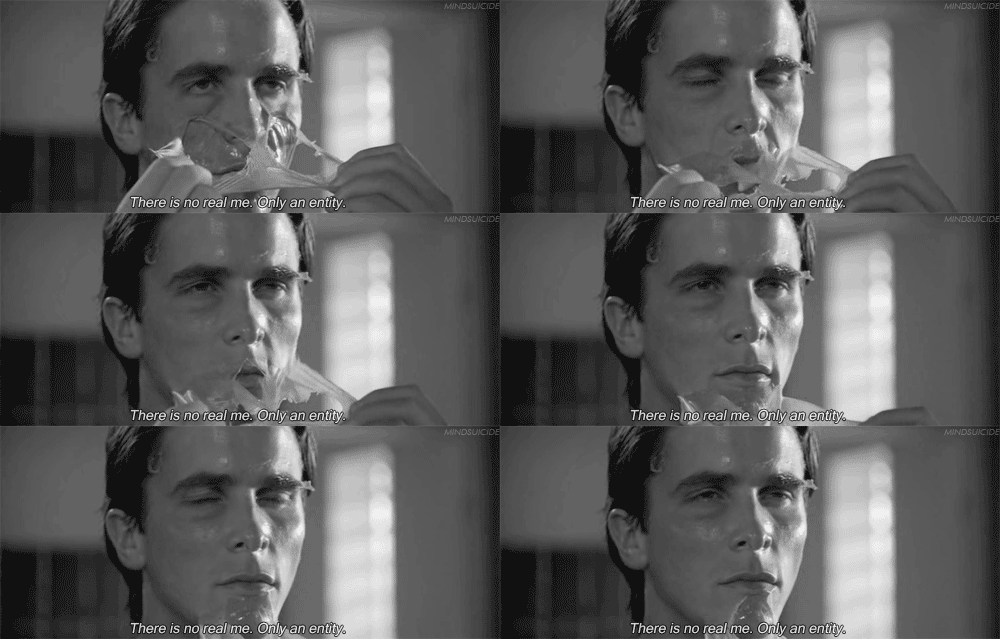
Thought Experiment: Do you show the real you?
Friday, November 18, 2011
Wednesday, November 16, 2011
Do we all feel this? or are you and I the only ones?
Tuesday, November 15, 2011
Open mind, Open thoughts, Open acceptance
I don't want salvation prayers. I don't want anyone to have to worry about me. Yes, I accept that people do in fact worry, but in light of world-view differences I feel like my lack of desire for heaven is very troublesome for the devout Christian. Years ago as a devout Christian myself, I personally agonized over friends and family I thought were going to hell... how could I not? I love these people and am deeply affected and influenced by their lifestyle and 'walk with God' yet at the same time saw apathy on issues Jesus himself directly addressed.